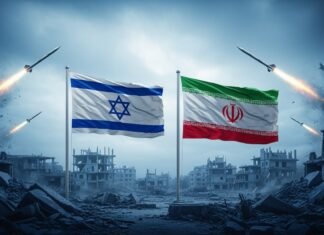
Prime Minister Benjamin Netanyahu of Israel has made a bold declaration, asserting that Israel will persist in its operations against Iran „on all fronts.” This statement comes in the aftermath of Iranian missile strikes that targeted the Israeli cities of Dimona and Arad, resulting in around one hundred injuries among civilians.
In a press release, Netanyahu reiterated Israel’s commitment to defend itself against its adversaries, emphasizing the nation’s resolve in the face of aggression. The situation escalated rapidly the following morning when the Israeli military launched airstrikes in central Tehran, marking a significant escalation in the ongoing conflict between the two nations. These aerial assaults were a direct retaliation for the Iranian attacks, which not only injured numerous individuals but also caused substantial damage in southern Israel. The nature of the explosions suggests that the Iranians may have employed conventional munitions with high explosive yields, signaling a serious threat.
The recent hostilities come against a backdrop of long-standing tensions between Israel and Iran, where both countries have continually engaged in a complex and multifaceted conflict. The Iranian strikes specifically targeted areas that are critical to Israeli security, heightening the fear among the population and prompting a swift military response to ensure national safety and deterrence.
The ongoing cycle of attacks and counterattacks highlights the precarious state of affairs in the region, where diplomacy has often faltered. Netanyahu’s statements amplify the narrative of an existential struggle against enemies that seek to undermine Israel’s existence. In this context, the Israeli government is likely to face pressure to adopt a more aggressive posture in its dealings with Iran, as public sentiment may demand robust action in light of the recent attacks.
Moreover, the repercussions of these incidents extend beyond immediate military reactions. They also have the potential to impact geopolitical dynamics in the Middle East, drawing in other regional players who have vested interests in the conflict. The international community watches closely as the situation evolves, understanding that any miscalculation could spiral into a broader confrontation that might involve multiple states.
While making this declaration, Netanyahu seeks to project strength, portraying Israel as a nation unyielding in its defense. His government is focused on ensuring the security of its citizens, and this recent escalation serves as a reminder of the challenges Israel faces in maintaining stability amid persistent threats. The Israeli military’s response will likely have implications for future strategic calculations, both in terms of military readiness and diplomatic engagements.
In conclusion, the assertion by Netanyahu to continue operations against Iran reflects a broader strategy aimed at deterring aggression and safeguarding national interests. The cycle of violence underscores the complexity of regional conflicts, where each action can provoke significant repercussions. As Israel navigates this turbulent terrain, the commitment to defend its territory and citizens remains paramount, even as the potential for escalation looms large. The Israeli response will be closely monitored, both domestically and internationally, as the situation in the Middle East continues to evolve.