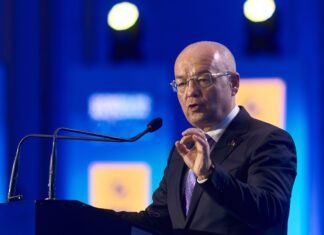
During a recent visit to Sydney, Australia, Canadian Prime Minister Mark Carney expressed his support for the military actions taken against Iran. However, he emphasized that this stance is adopted „with regret.” Carney’s comments come amid escalating tensions in the region, fueled by coordinated strikes from the United States and Israel targeting Iranian installations. The situation has rapidly deteriorated, leading to a series of retaliatory missile and drone attacks by Iran, aimed at Israel and U.S. Gulf allies.
Carney underscored that the ongoing crisis not only highlights immediate military confrontations but is also indicative of deeper, systemic issues regarding global security. He warned that Iran’s nuclear ambitions pose a significant threat not only to regional stability but to international peace as well. The implications of Iran’s actions extend beyond its borders, affecting global alliances and security frameworks.
In his remarks, Carney lamented the manner in which military operations have been executed, particularly criticizing the lack of consultation with allies and the minimal involvement of the United Nations. He pointed out that these factors undermine the collective approach that is crucial for addressing threats of this magnitude. The absence of coordinated international efforts could lead to further escalation and destabilization in a region already fraught with underlying tensions.
Carney’s comments resonate in a broader context of international relations, where unilateral actions can have far-reaching consequences. The need for a united front among nations becomes increasingly apparent when facing challenges that cut across borders and alliances. The Prime Minister urges all parties involved to prioritize de-escalation and dialogue over military confrontation. Establishing communication channels and engaging in diplomacy are essential steps toward mitigating the risks posed by Iran’s nuclear program and its implications for regional security.
Moreover, Carney’s assertion serves as a reminder of the precarious balance within the international community. The world is at a critical juncture where decisions taken by a few can impact the lives and security of many. Thus, it is imperative that nations, particularly those with significant military capabilities, pursue approaches that encourage collective security and compromise rather than provocations that can lead to warfare.
The Prime Minister of Canada appeals for a renewed commitment to international cooperation in the realm of security, suggesting that the global community must work together to find mutually beneficial solutions to ongoing conflicts. As tensions inflame and military responses become more frequent, he emphasizes that solutions grounded in collaboration are essential to achieving sustainable peace.
In conclusion, the current crisis involving Iran presents not only immediate military challenges but also significant questions about the future of international security frameworks. Carney’s remarks encapsulate a call for introspection among global leaders about how best to approach escalating conflicts. The message is clear: unilateral actions without consultation and cooperative engagement are fraught with peril, and the pursuit of peace necessitates a concerted effort by the global community to address core issues and foster stability.